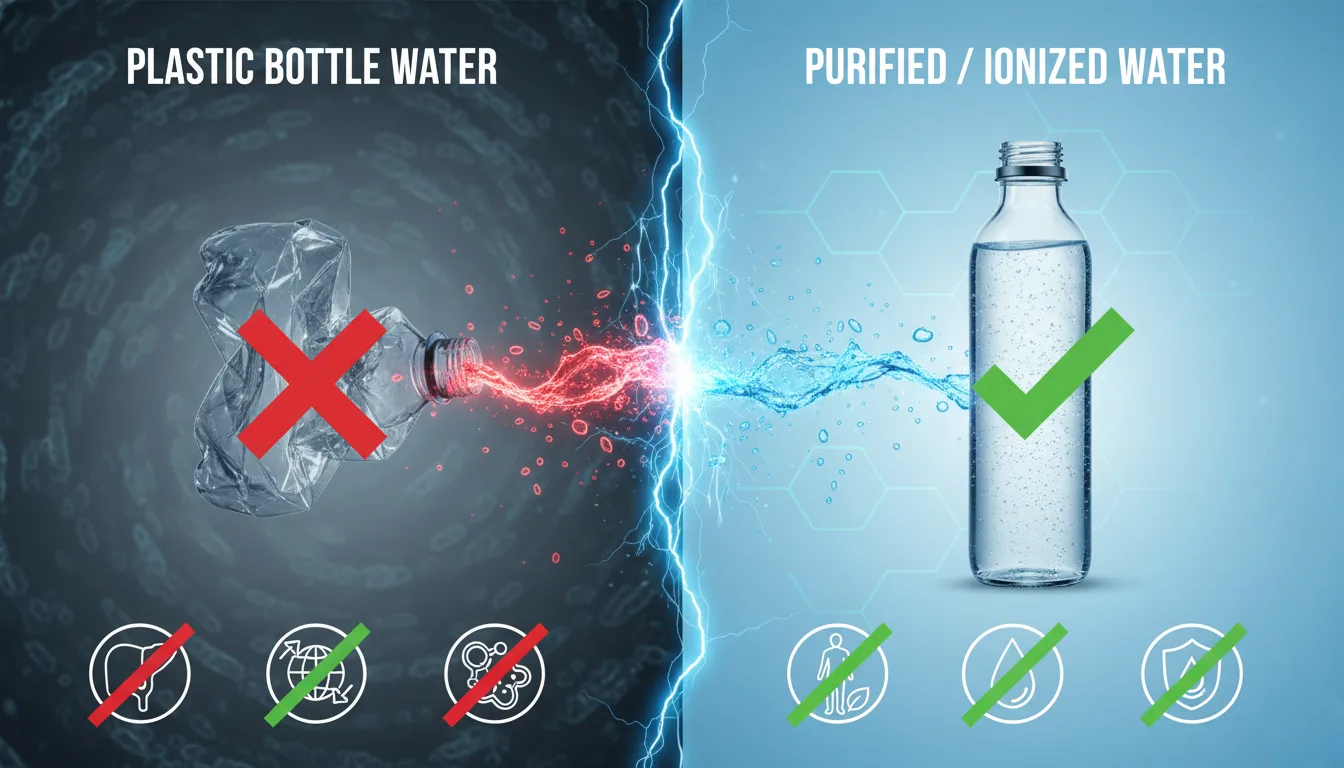
Bottled water sells on an image of purity — mountain springs, glacial sources, clean glass-blue labels. The research on what is actually in the bottle has been considerably less flattering, and it has arrived steadily over the past decade.
What the Studies Found
In 2018, a study coordinated by Orb Media and carried out at the State University of New York tested 259 bottles across eleven leading brands and nine countries. Microplastic particles were found in 93% of the bottles, averaging around 325 particles per litre.
A 2024 study published in the Proceedings of the National Academy of Sciences used a more sensitive imaging technique and found roughly 240,000 plastic fragments per litre in bottled water — the great majority of them nanoplastics, small enough to have gone undetected in earlier work.
Nanoplastics matter more than their larger counterparts because of where they can go. Particles at that scale can cross biological barriers that block bigger fragments. Research on what they do once there is ongoing and far from settled — but the exposure itself is now well documented.
Chemical Migration: BPA and Phthalates
Beyond the plastic particles themselves, there are the additives used to make the plastic. Bisphenol A and phthalates can migrate from container into contents, and migration accelerates sharply with heat and time — a case of bottles left in a warm warehouse, a delivery van in summer, or a balcony, is a different product from the one that left the factory.
Both are classed as endocrine disruptors: substances that can interfere with hormone signalling. The European Food Safety Authority substantially reduced its tolerable daily intake for BPA in 2023 after reviewing the evidence, and the EU has restricted BPA in food-contact materials. The regulatory direction of travel here has been consistently one-way.
The reasonable summary: exposure is real and regulators have been tightening limits, while the size of the health effect at typical consumer exposure is still being studied. Reducing avoidable exposure is a sensible precaution rather than a panic.
The Storage Problem
There is also a simple freshness issue. Large refillable carboys and bottled stock can sit for weeks or months between filling and drinking. Dissolved oxygen falls. Where a bottle has been opened and partly used, or where a carboy sits on a dispenser in a warm room, biofilm can develop around the neck and spout — which is why dispenser hygiene is a recurring theme in food-safety guidance.
The Environmental Arithmetic
A household drinking three litres a day gets through roughly 1,100 litres a year. In 1.5-litre bottles that is about 730 bottles, carried home, stored, and disposed of. Global PET bottle production runs to hundreds of billions of units annually, and recycling rates in most markets remain well below half.
The Alternative: Treat It Where You Drink It
Point-of-use treatment removes the packaging, the transport and the storage time from the equation. The water is produced at the moment you pour it.
A Singer ioniser filters through seven stages — sediment, GAC carbon, granular carbon, RO membrane, post carbon, ALK+ alkaline and vitamin B12 — removing chlorine, heavy metals, bacteria and viruses at 99.9% while retaining calcium, magnesium and potassium. The system is certified to NSF 42, 53, 58, 372 and 401, carries the WQA Gold Seal and CE marking, and produces around 295 litres a day.
Water drawn from a Singer unit and tested by an accredited laboratory measured pH 9.5 and ORP −252 mV. Store it in glass or stainless steel and the plastic is out of the chain entirely.
You can read how the filtration and ionisation stages work, compare the Gold and Black models, or request a free water test to see what is in your tap supply today.