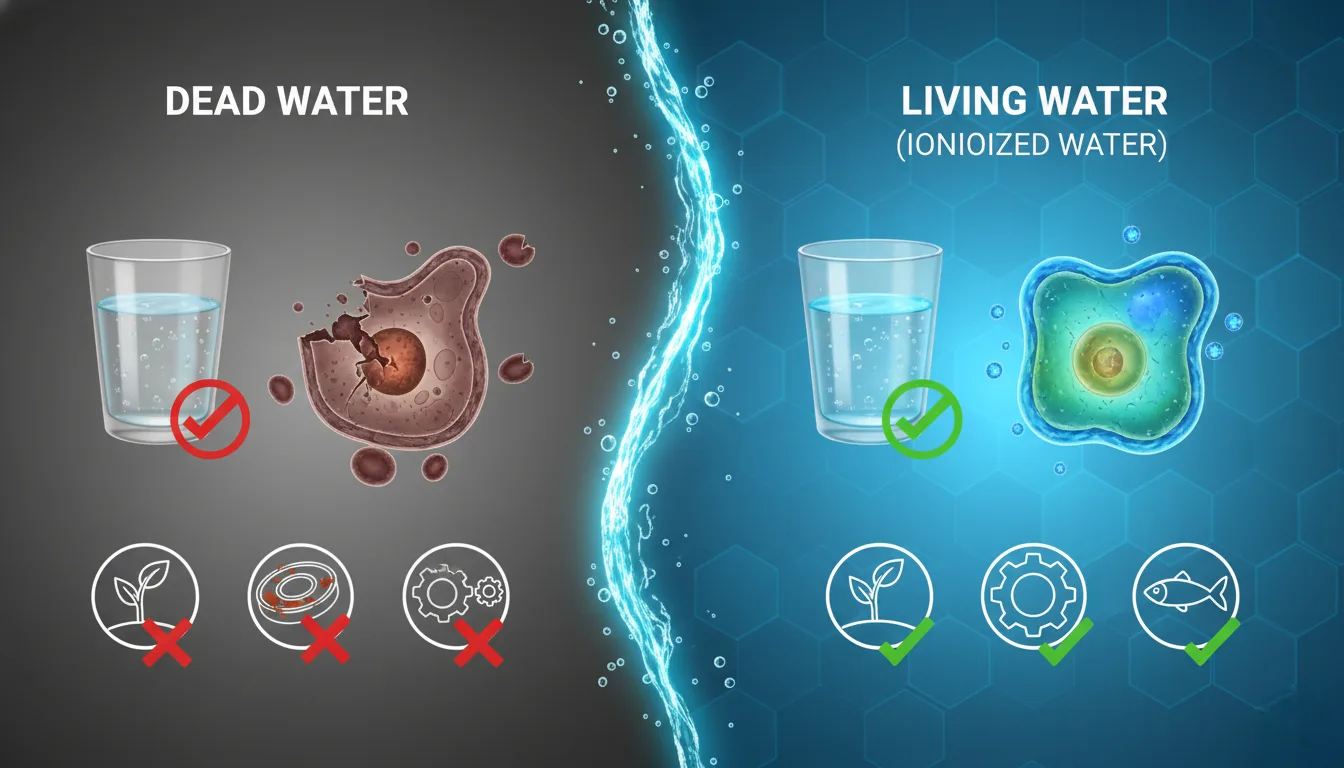
Not all drinking water is equivalent, even when all of it is safe. Two glasses can both pass a microbiological test and still differ in mineral content, dissolved gas, pH and oxidation-reduction potential — and those differences are measurable, not metaphorical.
The terms dead water and living water are marketing language rather than scientific classification. What they point at, though, is a real distinction: water that has been stripped and left standing versus water that is filtered, mineral-retaining and freshly treated at the point of use.
What People Mean by Dead Water
Three things generally get grouped under the label.
Demineralised water. A reverse osmosis membrane removes contaminants indiscriminately — and calcium, magnesium and potassium go out with the heavy metals. RO output typically measures pH 6 to 7, slightly acidic, with very little buffering capacity. The World Health Organization has published specific guidance on the nutritional implications of demineralised drinking water, noting the loss of calcium and magnesium intake where it becomes the sole source.
Long-stored water. Water sitting in a carboy or bottle for weeks loses dissolved oxygen and can pick up compounds migrating from the container. This is why bottled water tastes flatter than water from a tap that has just run.
Positively charged water. Tap and bottled water usually measure between +200 and +400 mV on the oxidation-reduction scale, meaning the water tends to accept electrons rather than donate them.
What Ionisation Actually Changes
Electrolysis passes water across charged plates, splitting the stream into an alkaline fraction and an acidic fraction. The alkaline output carries dissolved molecular hydrogen, and that is what produces the negative ORP reading.
In water sampled from a Singer unit, an accredited laboratory measured pH 9.5 and ORP −252 mV — a swing of several hundred millivolts against typical tap water.
Molecular hydrogen is an active research area. A substantial body of preclinical and early clinical work has examined it as a selective antioxidant, and results are interesting enough to sustain serious study. It is not, at this stage, established therapy for anything, and it should not be presented as such.
A Note on Micro-Clustering
You will often see the claim that ionised water forms smaller molecular clusters that pass into cells more easily, sometimes with a specific multiplier attached. This is not supported by the physical chemistry — hydrogen-bonded clusters in liquid water rearrange on a picosecond timescale, far too fast for any stable structure to persist. We would rather say so plainly than repeat a claim we cannot stand behind.
Comparing the Three
| Property | Stored bottled water | Reverse osmosis | Singer alkaline ionised |
|---|---|---|---|
| pH | 5.5–7.5 | 6–7 | 8.5–9.5 (accredited: 9.5) |
| ORP | +200 / +400 mV | +100 / +300 mV | −252 mV (accredited) |
| Minerals | Source-dependent | Removed | Retained and re-introduced |
| Freshness at pouring | Weeks to months | Point of use | Point of use |
| Microplastic exposure | Documented | Low | Low |
The Honest Summary
Ionised water is not alive and ordinary water is not dead. What is true is narrower and still worth having: water that keeps its minerals instead of discarding them, that is produced fresh instead of stored for months, that measures negative rather than positive on the ORP scale, and that tastes good enough to drink two litres of without effort.
You can read how the seven filtration stages and the electrolysis cell work, compare the Gold and Black models, or request a free water test.